Back to Crop Potential
Orchard
Pomegranate
From 6 to 20+ tonnes per acre per year. Bhagwa variety with drip, bagging and pest management out-yields Iran and matches Spain.
From 6 to 20+ tonnes per acre per year. Bhagwa variety with drip, bagging and pest management out-yields Iran and matches Spain.
Most farms in India operate well below their yield potential. The gap is rarely about land or weather. It is about which seed, which water, which feed, and which decisions, made on which day. Here is what we are aiming for.
No magic. No buzzwords. Each of these is a small lever. Pulled together, they compound into the yield you see above.
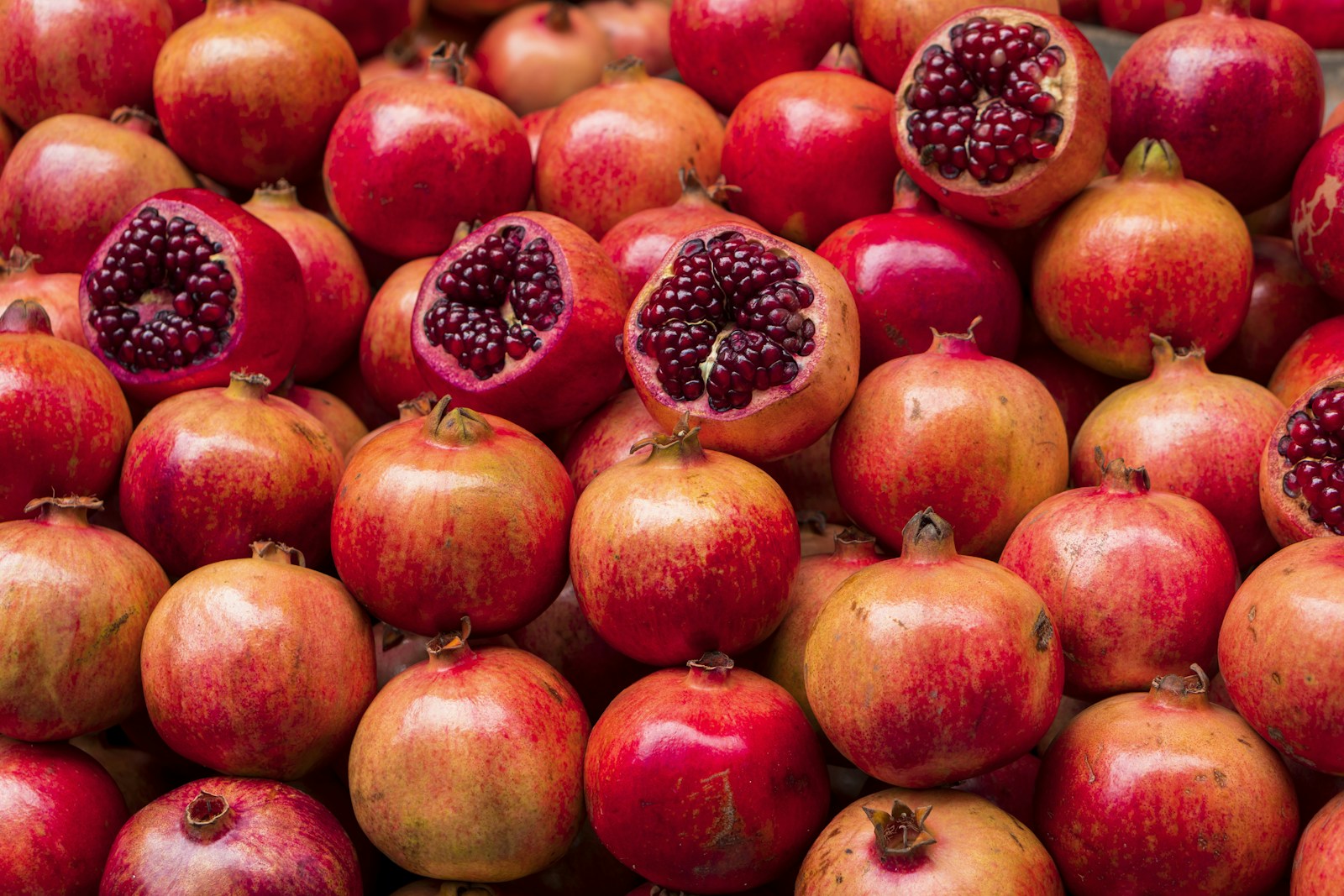
Bhagwa fruits are large, deep red, soft-seeded and travel well. Premium export and modern-retail buyers ask for it by name. Yield per tree at maturity is 30-40 kg, against 15-20 kg for older varieties.
Pomegranate roots are surface feeders and shallow. Drip with daily fertigation gives the right water and nutrients without leaching. Fruit cracking and split drop sharply.
A non-woven fruit bag fitted at the size of a lemon protects from sunburn, fruit-borer and bird damage. Skin colour stays even, A-grade share rises from 50-60% to 80-90%.
Pomegranate flowers in three bahars (mrig, hasta, ambe). We pick the bahar that hits the highest-price window for the local market by withholding water and pruning at the right time.
Bacterial blight (telya) can wipe an orchard in two seasons. Drip (no overhead water), strict pruning hygiene, copper-based sprays at the right stage and resistant clones together hold disease below 5%.
Spacing of 4.5 x 3 m or 5 x 3 m fits 220-280 trees per acre, against 150 in older orchards. Pruning keeps each tree to a 2.5-3 m bush, easy to harvest and spray.
From day one to harvest, here is the actual work. Plain English. No jargon. This is the playbook we follow on every farm we manage.
Soil tested for pH, salinity and nematode load. Pomegranate prefers pH 6.5-7.5 and well-drained loam. 60x60x60 cm pits with FYM, rock phosphate and neem cake.
Only certified, true-to-type Bhagwa air-layers from accredited nurseries. 250 trees per acre at 5x3 m or 4.5x3 m spacing.
2 drippers per tree at 4 lph initially, scaling to 4 as canopy spreads. Fertigation tank for stage-wise NPK and micronutrient delivery.
Single-stem or multi-stem (3-4) training in year 1. Annual pruning post-harvest to keep canopy open at the centre. Water shoots and crowded branches removed.
Selected bahar (mrig, hasta or ambe) followed for 3-4 years on a stretch. Off-season irrigation withheld for 45-60 days before the chosen bahar to force flowering.
Copper-based pre-monsoon spray. Fruit bagging at lemon size for fruit-borer. Pruning shears sterilised between trees.
Picked at full deep-red colour, graded by size (A: above 250 g, B: 200-250 g, C: below 200 g). Cold chain to buyer within 24 hours.
What happens, when. So you know the path, the wait, and the pay-off, before you start.
Pits prepared, drip and mulch in, Bhagwa air-layers planted at the start of monsoon.
Tree trained to single or multi-stem. Flowers pinched in year 1, light fruit allowed in year 2.
3-5 t/acre. Bahar regulation kicks in. Buyer onboarded.
8-12 t/acre. A-grade share rises with bagging. Trees still adding 15-20% per year.
15-20+ t/acre. Productive for 12-18 years before replant cycle.
What it costs, what it returns, when it pays back. Honest ranges, not best-case-only numbers.
Every yield range here is anchored to research from Indian and international institutions. Not marketing. Not anecdote.
Bhagwa pomegranate at 250-300 trees per acre under drip-fertigation in Maharashtra and Karnataka delivers 15-22 t/acre/year against 6-10 t/acre in older Ganesh and Mridula plantings.
Strict pruning hygiene, copper-based pre-monsoon sprays and drip (no overhead water) reduce bacterial blight (telya) incidence from 25-40% of trees affected to under 5%.
Bhagwa is the dominant Indian export pomegranate variety, with markets in UAE, UK, Bangladesh and Russia paying 30-60% premium for A-grade fruit (above 250 g, deep red, unblemished).
Among major producers, Iran averages 15-20 t/ha and Spain 18-25 t/ha; India's national average sits around 12-15 t/ha despite leading in total volume, indicating significant per-hectare upside.
We map your land, soil, water and current practice against the targets above and tell you, honestly, what your farm can actually deliver. No charge for the first conversation.
Get a Yield-Potential Audit