Back to Crop Potential
Spice
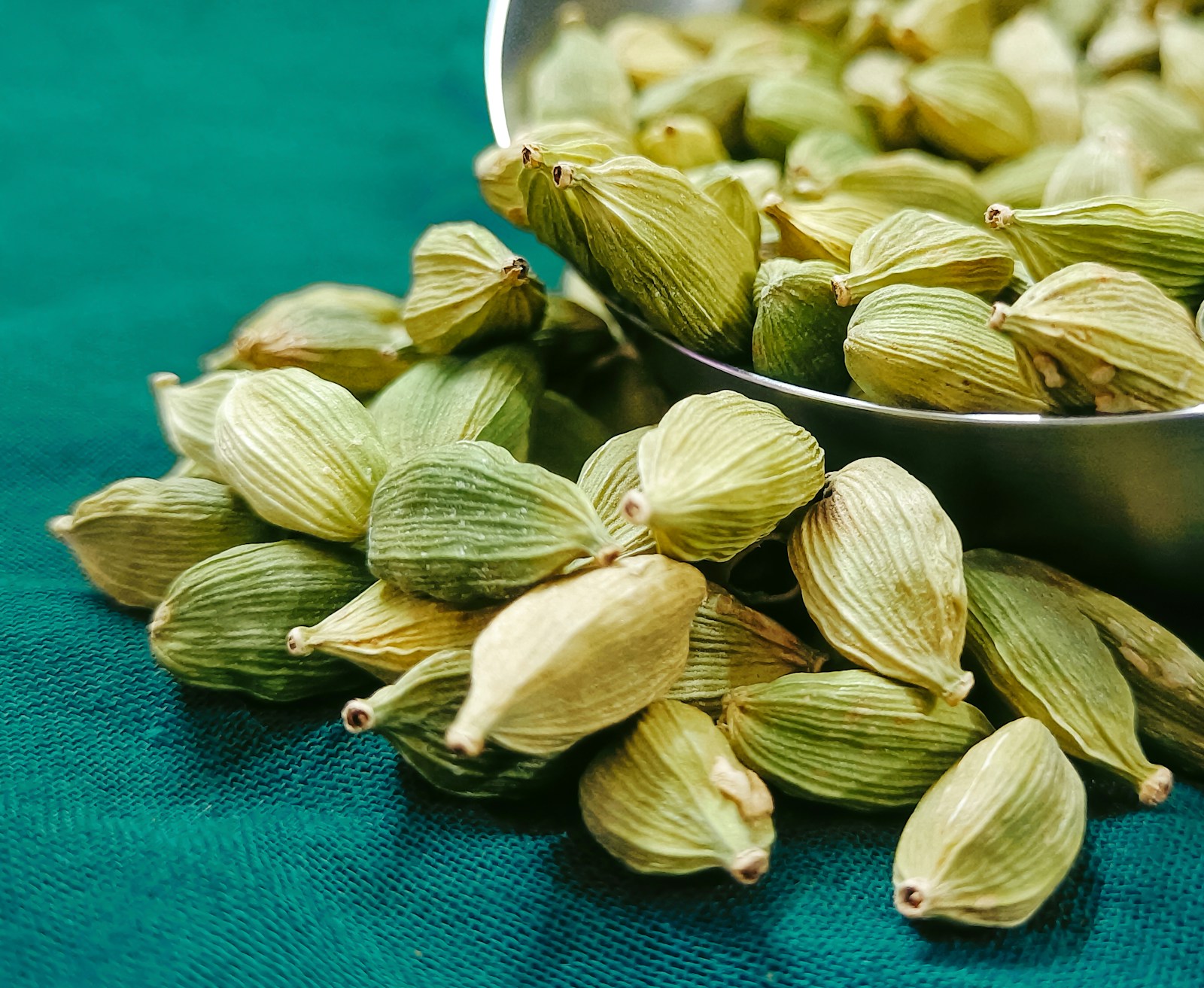
Cardamom
From 80 to 350+ kg per acre per year. Njallani green-gold variety with right shade and irrigation rivals Guatemala.
From 80 to 350+ kg per acre per year. Njallani green-gold variety with right shade and irrigation rivals Guatemala.
Most farms in India operate well below their yield potential. The gap is rarely about land or weather. It is about which seed, which water, which feed, and which decisions, made on which day. Here is what we are aiming for.
No magic. No buzzwords. Each of these is a small lever. Pulled together, they compound into the yield you see above.
Njallani (Green Gold) from Idukki is a clonally selected high-yield cardamom variety. It produces 1.5-2.5 kg dry per plant at full maturity against 0.3-0.5 kg from old clumps. Same shade, same care, far higher yield.
Cardamom is an understorey crop. 50-60% shade is ideal. Natural forest shade is often too dense; we thin upper canopy yearly so dappled light reaches the panicles.
Cardamom yield falls 30-40% in a dry summer. Drip with daily small doses through the dry months keeps panicle initiation steady. Yield curve flattens out across the year.
Cardamom roots are shallow and continuous. Three NPK splits a year, with extra magnesium and zinc, plus a vermicompost basal application. Lifts capsule fill 20-30%.
Mosaic virus (katte) and capsule rot are the killers. Virus-indexed planting material from KAU and ICAR-IISR Calicut, plus weekly scouting and immediate uprooting of infected clumps, holds katte under 10%.
Sun-dried capsules go bleached and lose price. Bin-cured at 45-50 degC over 24-30 hours preserves the deep green colour and oil content. Green-gold capsules fetch 30-50% premium over standard.
From day one to harvest, here is the actual work. Plain English. No jargon. This is the playbook we follow on every farm we manage.
Cardamom needs 1500-3000 mm rainfall, 10-25 degC, well-drained loam pH 5-6.5, partial shade. Existing shade trees mapped. Light-meter reading taken.
Only virus-indexed, clonally propagated Njallani, IISR Avinash or KAU-Vazhukka suckers from accredited nurseries. 1,000 plants per acre at 2x2 m or 2.5x1.5 m spacing.
45x45x45 cm pits with FYM, neem cake, rock phosphate and vermicompost. Sucker planted at start of monsoon.
One dripper per clump at 2 lph. Daily small doses December to May. Mulch ring under each clump.
Upper canopy of natural shade trees pruned twice a year. Light-meter reading kept at 50-60% of full sun. Old shade replaced with silver-oak or Erythrina if too dense.
Weekly scout for mosaic symptoms; any infected clump uprooted within 24 hours. Yellow sticky traps for thrips. NSKE or BT on threshold breach. No prophylactic chemical spraying.
Capsules picked at 75-80% maturity, every 30-40 days through October-February. Bin-cured at 45-50 degC over 24-30 hours. Graded by size and colour.
What happens, when. So you know the path, the wait, and the pay-off, before you start.
Pits prepared. Shade audited. Virus-indexed suckers planted at start of monsoon.
Mother plant produces 5-8 daughter tillers. Shade thinned. First fertigation cycle.
80-150 kg dry per acre. Buyer onboarded.
200-280 kg dry per acre. A-grade green-gold share rises.
300-350+ kg dry per acre. Productive for 8-12 years before replant cycle.
What it costs, what it returns, when it pays back. Honest ranges, not best-case-only numbers.
Every yield range here is anchored to research from Indian and international institutions. Not marketing. Not anecdote.
Clonally selected high-yield cardamom varieties Njallani, IISR Avinash and KAU-Vazhukka under drip and shade management deliver 300-400 kg dry/acre/year against 80-150 kg/acre on old unselected clumps.
Virus-indexed planting material plus weekly scouting and prompt removal of infected clumps reduce katte (mosaic) incidence from 30-50% of clumps affected to under 10%.
Bin-cured green-gold capsules with intact oil and deep green colour command 30-50% premium over sun-dried bleached capsules in domestic and export markets.
Guatemala (around 350-400 kg/ha) leads global cardamom yield, with India trailing at 200-250 kg/ha despite having the older germplasm base; the gap is mostly in clonal selection and drip adoption.
We map your land, soil, water and current practice against the targets above and tell you, honestly, what your farm can actually deliver. No charge for the first conversation.
Get a Yield-Potential Audit