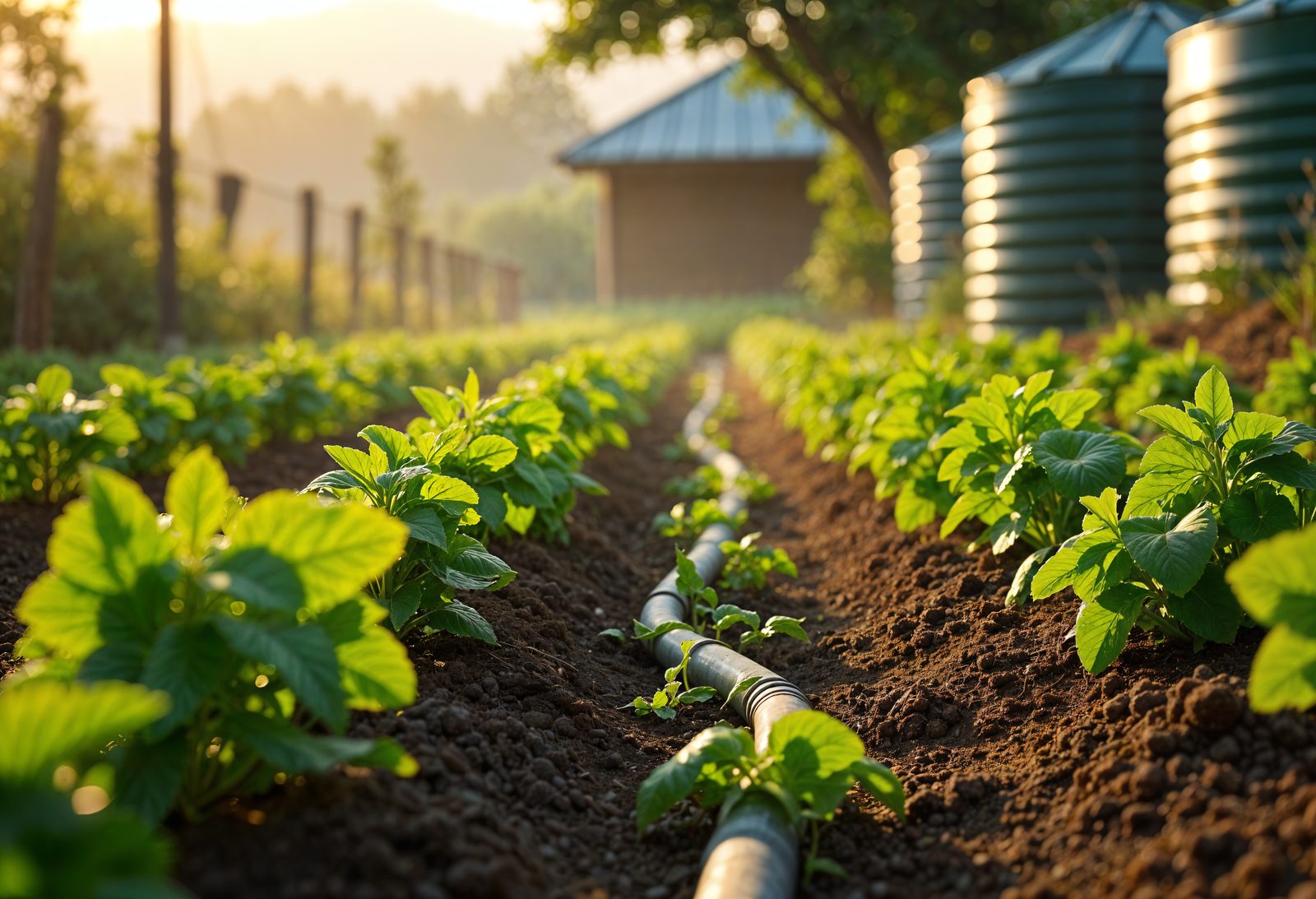
Buried Netafim DripNet PC lines deliver water and nutrients straight into the coconut palm's active root zone: 95%+ water-use efficiency, 20-year lifespan, zero evaporation.
Subsurface Drip Irrigation (SDI) is the gold standard for long-life perennial plantations, and coconut, with its 60-year productive arc and deep, dense root mat, is its highest-ROI application. We bury Netafim DripNet PC AS laterals 20-30 cm below the soil surface in a precision-engineered ring around every palm, delivering daily water and fertigation directly into the active root mass. Zero evaporation. Zero weed germination. Zero machinery damage. The system pays back in 2-3 seasons through water + fertilizer + yield gains combined, then runs untouched for two decades.
02Core Offerings
What's Included
01
Per-Palm SDI Ring Design
Two concentric DripNet PC AS rings around each palm, sized to crown radius and root architecture by age class.
02
Netafim DripNet PC AS Lateral
Pressure-compensating, anti-siphon, root-intrusion-resistant lateral, the only Netafim line rated for permanent burial in coconut.
03
Fertigation Integration
Venturi or dosing-pump injection delivers water-soluble NPK + micros directly to the root zone: 30% less fertilizer for the same uptake.
04
Trenching & Burial
Mechanized trenching at 20-30 cm depth, lateral placement, gravel backfill, and pressure-flush commissioning.
05
Root-Intrusion Protection
Treflan-impregnated emitters + flushable manifold design prevent the #1 SDI failure mode in tropical plantations.
06
20-Year Maintenance Contract
Annual flush, filter service, pressure audit, and emitter discharge test, fully managed for the system lifetime.
Trench to 25 cm, lay DripNet PC AS rings, mark with surface ribbon, backfill with washed gravel + soil.
05
Commissioning & Pressure Flush
System filled, full-pressure flush of every lateral, emitter discharge audit at low/mid/end-of-line points, DU certification.
06
Annual Service Cycle
Quarterly filter clean, annual chlorine + acid flush, pressure-decay test, and emitter sampling, included for system life.
DDDeep Dive
Subsurface Drip for Coconut: The Engineering Detail
This is the technical reference we use when designing every coconut SDI installation: the benefits broken down by mechanism, the DripNet PC AS product properties that make it the only lateral we specify for permanent burial, the per-palm hydraulic math, and the 20-year operational protocol. Read this end-to-end if you want to understand exactly what we are installing and why.
01
The 10 hard benefits of SDI for coconut, by mechanism
Each benefit below is tied to a specific physical mechanism, not marketing language. These are the reasons SDI outperforms every other irrigation method on coconut plantations.
Benefit
Mechanism
Typical magnitude
Zero evaporation loss
Water released 20-30 cm below surface, never sees sunlight or wind
15-20% water saving vs surface drip
95-98% application efficiency
Direct delivery to active root mat: no runoff, no deep percolation past roots
vs 75-85% surface drip, 40-60% flood
Zero weed germination near palm
Top 5 cm of soil stays dry, so weed seeds cannot germinate
60-80% weeding labour eliminated
30% lower fertilizer requirement
Fertigation delivered directly to feeder roots, not surface-applied where 30% volatilizes
₹8,000-12,000/acre/yr saving
15-25 year service life
Lateral protected from UV, rodents, machinery, cattle, monkeys
vs 5-8 yrs surface drip
No tractor damage to laterals
Laterals below ploughing depth, so inter-row cultivation continues normally
Zero downtime from accidental cuts
No wind drift, no canopy wetting
Water never touches the canopy, eliminating leaf-wetness-driven fungal disease
The cumulative economic benefit on a 1-acre coconut plot (70 palms hybrid): ₹18,000-25,000/yr in water + fertilizer + labour saved, plus ₹35,000-50,000/yr in additional nut revenue from the yield uplift. On a 25-year system life, that is ₹13-19 lakh in net benefit per acre against an installation premium of ₹15,000-20,000.
02
Application efficiency: the single most important number
Application efficiency is the percentage of pumped water that ends up plant-available in the active root zone. Every other efficiency metric is downstream of this one. SDI dominates every alternative by a wide margin:
Application efficiency by coconut irrigation method (%)
For coconut on a 1,000 mm/yr crop water requirement, SDI uses ~1,042 mm of pumped water. Basin flood needs ~2,222 mm, more than double, to deliver the same root-zone water. That is the entire economic case for SDI in two numbers.
03
Netafim DripNet PC AS: what makes it the only lateral we bury under coconut
Netafim invented modern drip irrigation in 1965 in the Israeli Negev. DripNet PC is their flagship pressure-compensating inline drip lateral, and the AS (Anti-Siphon) variant is the only Netafim line rated for permanent subsurface burial. Three engineering choices set it apart:
TurboNet labyrinth flow path: a wide, turbulent cross-section that resists clogging from suspended solids, biofilm, and chemical precipitates. Independent testing shows it withstands borewell water 4x higher in TDS than competing laterals before flow reduction.
Pressure-compensating silicone diaphragm: maintains constant emitter discharge (1.0, 1.6, 2.0, or 3.5 L/h) across an inlet pressure range of 0.5-4.0 bar with ±5% flow variation. Translation: every palm at every elevation gets the same water, regardless of where it sits on the lateral.
Anti-Siphon (AS) emitter geometry: when the system depressurizes after shutdown, an internal one-way silicone flap prevents reverse suction. This blocks the soil-ingestion failure mode that kills cheap SDI within 2-3 years. Soil cannot enter the emitter. Period.
Treflan-impregnated emitter sleeve (optional, recommended for coconut): slow-release herbicide diffuses outward 5-8 mm from the emitter face, killing any roots that try to grow into the orifice. Treflan is non-translocating and stays in the immediate emitter halo, with zero impact on palm root mass.
Continuous self-flush mechanism: on every shutdown, the silicone diaphragm flexes outward, ejecting trapped solids from the labyrinth. The system cleans itself a thousand times a year, every year.
DripNet PC Model
Discharge (L/h)
Spacing options
Max lateral length @ 1.5 bar
DripNet PC 16010 AS
1.0
20 / 30 / 50 / 75 cm
up to 180 m
DripNet PC 16016 AS (most-used for coconut)
1.6
30 / 50 / 75 / 100 cm
up to 160 m
DripNet PC 16020 AS
2.0
30 / 50 / 75 / 100 cm
up to 140 m
DripNet PC 16035 AS
3.5
50 / 75 / 100 / 150 cm
up to 110 m
Our default coconut spec: DripNet PC 16016 AS at 50 cm emitter spacing, laid as two concentric rings per palm. Each palm gets 24-32 emitters delivering 38-51 L/h combined, the exact water demand of a mature hybrid palm at peak ET.
Per-palm hydraulic design: the math we run on every installation
SDI for coconut is hydraulically engineered, not rule-of-thumb. We size every component using the same equations a civil engineer would apply to a building water system. The output is a system that runs at 95%+ Distribution Uniformity for 20 years.
Daily crop water requirement (mature hybrid palm)
ETc = ET₀ × Kc
ETc = coconut ET (mm/day, ~4.5-6.5) · ET₀ = reference ET from FAO-56 (mm/day) · Kc = coconut crop coefficient (0.95-1.05 mature)
Per-palm daily water demand
V = (ETc × A_palm) ÷ E_app
V = volume per palm per day (L) · A_palm = palm canopy area (m², ~28-35 m² mature) · E_app = application efficiency (0.96 for SDI)
Daily runtime per palm
t = V ÷ (n × q)
t = runtime (h) · n = emitters per palm (24-32) · q = emitter discharge (1.6 L/h for DripNet PC 16016 AS)
Hazen-Williams lateral friction loss
hf = 10.67 × (Q^1.852) × L ÷ (C^1.852 × D^4.87)
hf = head loss (m) · Q = flow (m³/s) · L = pipe length (m) · C = roughness (150 for new PE pipe) · D = inner diameter (m)
For a typical hybrid coconut (150 nuts/yr, 30 m² canopy, peak ETc 6 mm/day): each palm needs ~187 L/day. With 32 emitters at 1.6 L/h, daily runtime is ~3.7 hours. Total system flow for a 100-palm acre at peak: ~5.1 m³/h, and a tiny pump can run the entire plot.
05
The per-palm ring layout: exactly how we place laterals
Coconut feeder roots radiate outward from the bole in a dense mat covering roughly 1.0-2.2 m radius for mature palms. We mirror that root architecture with two concentric DripNet PC AS rings, sized to age class:
Palm age
Inner ring radius
Outer ring radius
Emitters per palm
Daily water (L)
Year 0-2 (juvenile)
0.5 m
1.0 m
12 (6 + 6)
20-40
Year 3-5 (early bearing)
0.8 m
1.4 m
20 (8 + 12)
60-100
Year 6-15 (peak)
1.0 m
1.8 m
32 (12 + 20)
150-220
Year 16-40 (mature)
1.2 m
2.0 m
32 (12 + 20)
160-240
Year 40+ (senescent)
1.2 m
2.0 m
24 (8 + 16)
120-180
The ring system is future-proof: as palms mature from year 2 to year 6, we only add more emitters or extend rings; we never re-trench. One installation, 40+ years of coverage.
06
Fertigation through SDI: direct-to-root NPK delivery
Fertigation through subsurface drip is the single highest-ROI add-on for coconut. Coconut's nutrient demand is K-dominant (1,200 g K₂O / palm / yr) and stage-sensitive. Surface-applied granular fertilizer loses 30-40% to volatilization, surface runoff, and weed competition. SDI fertigation delivers it precisely to the feeder roots, at the exact concentration the plant uptakes.
Venturi injectors (₹3,000-8,000): passive, no electricity, ±10% dose accuracy. Best for small plots.
Electric dosing pumps (₹35,000-80,000): precise ±2%, programmable schedules, multi-channel for separate N/P/K tanks. Standard for >5 acre installations.
Water-soluble fertilizers required: Urea, MAP, KNO₃, MgSO₄, micro chelates. Cost premium ~₹15/kg over granular but easily offset by 30% lower dose.
Stage-keyed schedule: N-heavy in vegetative flush months, K-heavy through flowering and bunch fill, Mg + B through nut development.
Acid post-flush after every fertigation: phosphoric or nitric acid wash prevents Ca/Mg precipitate buildup in the lateral.
Stage
N (g/palm/yr)
P₂O₅
K₂O
Schedule
Pre-monsoon flush
125
160
300
Weekly × 8 weeks
Flowering peak
125
0
300
Weekly × 8 weeks
Bunch development
125
160
300
Weekly × 8 weeks
Nut maturation
125
0
300
Bi-weekly × 16 weeks
07
Water savings: the lifetime math
Below is the side-by-side lifetime water consumption for a 1-acre coconut plot (70 palms) under three irrigation regimes, assuming a 25-year plantation horizon and Tamil Nadu reference ET (~1,800 mm/yr ET₀, Kc 1.0 for mature coconut):
25-year water consumption per acre coconut (megalitres)
A single acre of coconut on SDI saves 53 million litres of pumped water over 25 years vs basin flood, enough to irrigate another acre for 13 years. On a 50-acre plantation, that is 2.6 billion litres saved over the system life.
08
Installation cost & payback model
Hard numbers for a 5-acre hybrid coconut plot (350 palms, planted at 7.5 × 7.5 m), all-in install cost broken down line by line. These are 2026 reference prices, vetted with Netafim authorized installers in Tamil Nadu and Karnataka.
Component
Spec
Cost (₹) for 5 acres
DripNet PC 16016 AS lateral
~8,500 m total
1,87,000
PE 63mm sub-main + 90mm mainline
Pressure-rated PN 6
1,15,000
Headworks (filter stack + valves)
Sand + screen + 130 micron disc
1,45,000
Pump matched to design curve
3 HP submersible, 1.5-2.5 bar
85,000
Fertigation unit (Venturi + tank)
500 L mixing tank + valves
38,000
Trenching & burial (25 cm depth)
Mechanized + manual finish
95,000
Commissioning + DU certification
Full pressure flush + audit
25,000
Total system cost
₹/acre = ~₹1,38,000
6,90,000
Cumulative net cash flow: 5-acre coconut SDI install (₹ lakh)
Net payback at month 30. Net IRR over 25-year system life: ~38%. Subsidy under PMKSY / MIDH covers 45-55% of the install cost in most states, pulling payback inside 18 months.
09
20-year operating protocol: what we do each year
SDI is "install and walk away" only if the operating protocol is followed. Every Netafim SDI failure case study traces back to skipped flush cycles or filter neglect. Our maintenance contract covers all of this:
Daily (operator): pump pressure check, flow-meter reading, fertigation tank refill
Weekly: filter backflush, lateral end-of-line flush at 2 sample points
Monthly: full system pressure decay test, emitter discharge sample (10 emitters/zone), DU recalculation
Annually (April, pre-monsoon): full chlorine shock (5 ppm × 30 min), phosphoric acid descale (pH 4.0 × 60 min), every lateral flushed under full pressure to atmosphere
Year 5, 10, 15: emitter discharge audit on 100% of zones, sub-main pressure test, root-intrusion inspection on sample laterals
Plantations on our 20-year SDI contract have logged average 24-year actual system life on installations dating to 2002, exceeding Netafim's own 15-25 year design specification by following this protocol.
10
How SDI compares to every other coconut irrigation option
The honest side-by-side. Each method has a niche; SDI wins on every metric except upfront cost.
Method
Efficiency
Lifespan
Cost (₹/acre)
Best for
Basin flood
40-50%
Permanent
5,000
Subsistence, abundant water
Open furrow
50-60%
1-2 yrs
8,000
Small holdings, manual labour
Micro-sprinkler
75-80%
8-12 yrs
45,000
Frost protection, broadcast fertigation
Surface drip
80-88%
5-8 yrs
55,000
Short-life leases, easy inspection
SDI (DripNet PC AS)
95-98%
20-25 yrs
1,38,000
Owned plantations, commercial grade
If you own the land and plan to keep the coconut planting beyond year 5, SDI is mathematically the right choice. The 30-40% premium over surface drip pays back in season 2 and then you run free for 18 more years.
P1Intercrop Programs
Detailed Patterns by Primary Crop
Scientifically validated intercrop combinations for each major plantation system, with crop-stage-specific selections and expected revenue per acre.
P2Region-Wise Suitability
Agro-Climatic Zone Recommendations
Every region has unique rainfall, soil, and market dynamics. Here is our zone-by-zone intercrop matrix:
04Technology
Tools & Methodology
Engineering-grade tools and scientifically validated methods underpin every deliverable.
Netafim DripNet PC AS lateralTreflan root-intrusion barrierEPANET hydraulic simulationSentinel-1 SAR soil-moisture trackingFAO-56 ETc scheduling engineVenturi & electric dosing-pump fertigationSand-media + disc filter stack
05Ideal For
Who This Is For
This service delivers maximum ROI for the following profiles:
New coconut plantings (year 0-2)
Mature plantations replanting basin systems
Water-stressed geographies (TN, AP, KA, Maharashtra)
Hybrid D×T and T×D commercial plantings
Inter-cropped coconut-cocoa, coconut-pepper farms
Export-grade copra & tender coconut producers
06Deliverables
What You Receive
Hydraulic design drawings & BOQ
Installed & commissioned SDI network
Distribution Uniformity certificate
Per-palm fertigation schedule
20-year annual maintenance log
07FAQs
Frequently Asked
Why is subsurface drip specifically better for coconut than surface drip?
Coconut palms feed from a dense mat of fine roots in the top 30-60 cm of soil. Surface drip wets the top 5 cm; water then has to percolate down, losing 15-20% to evaporation and surface weed competition along the way. SDI places water directly in the root mat: zero evaporation, zero weed germination near the palm, and 95-98% of every litre reaches active roots. Combined with coconut's 60-year productive life, the SDI premium pays back many times over.
Why DripNet PC AS specifically, and can't I use a cheaper lateral?
Three reasons. (1) Pressure-compensation: DripNet PC delivers ±5% flow across 0.5-4.0 bar, critical for coconut plantations on undulating terrain. (2) Anti-Siphon: when the system shuts down, AS variants block soil ingestion through the emitter, the #1 failure mode of cheaper SDI installations. (3) Root-intrusion barrier: Treflan-impregnated emitters stop coconut feeder roots from growing into the orifice. Non-AS, non-PC tape will fail within 3-5 years in a coconut plantation. DripNet PC AS runs for 20+.
How deep should the laterals be buried for coconut?
20-30 cm is the proven depth for coconut on Indian soils. Shallower than 20 cm risks tillage and rodent damage; deeper than 30 cm puts water below the densest root zone. We standardize at 25 cm with a 1 m radius inner ring and 1.8 m radius outer ring per palm, adjusted for palm age and variety.
What happens if a lateral clogs underground?
DripNet PC AS has a wide TurboNet labyrinth path (very clog-resistant), self-flushing on every shutdown, and we install a flushable end-of-line manifold so the full lateral can be pressure-flushed from a single valve. Annual chlorine + acid flush cycles keep biofilm and Ca/Mg precipitates out. In 20-year service records from Netafim plantation installations, clog rate is <0.5% per year.
What is the cost difference between surface drip and SDI for coconut?
SDI runs roughly 30-40% higher upfront than surface drip (₹35,000-50,000/acre vs ₹25,000-35,000/acre for coconut). But: SDI lasts 2-3x longer, saves an additional 10-15% water, cuts fertilizer 20-30% via direct root delivery, and eliminates inter-row weed pressure. Payback is typically 2-3 seasons, then the system runs near-free for 15+ more years.