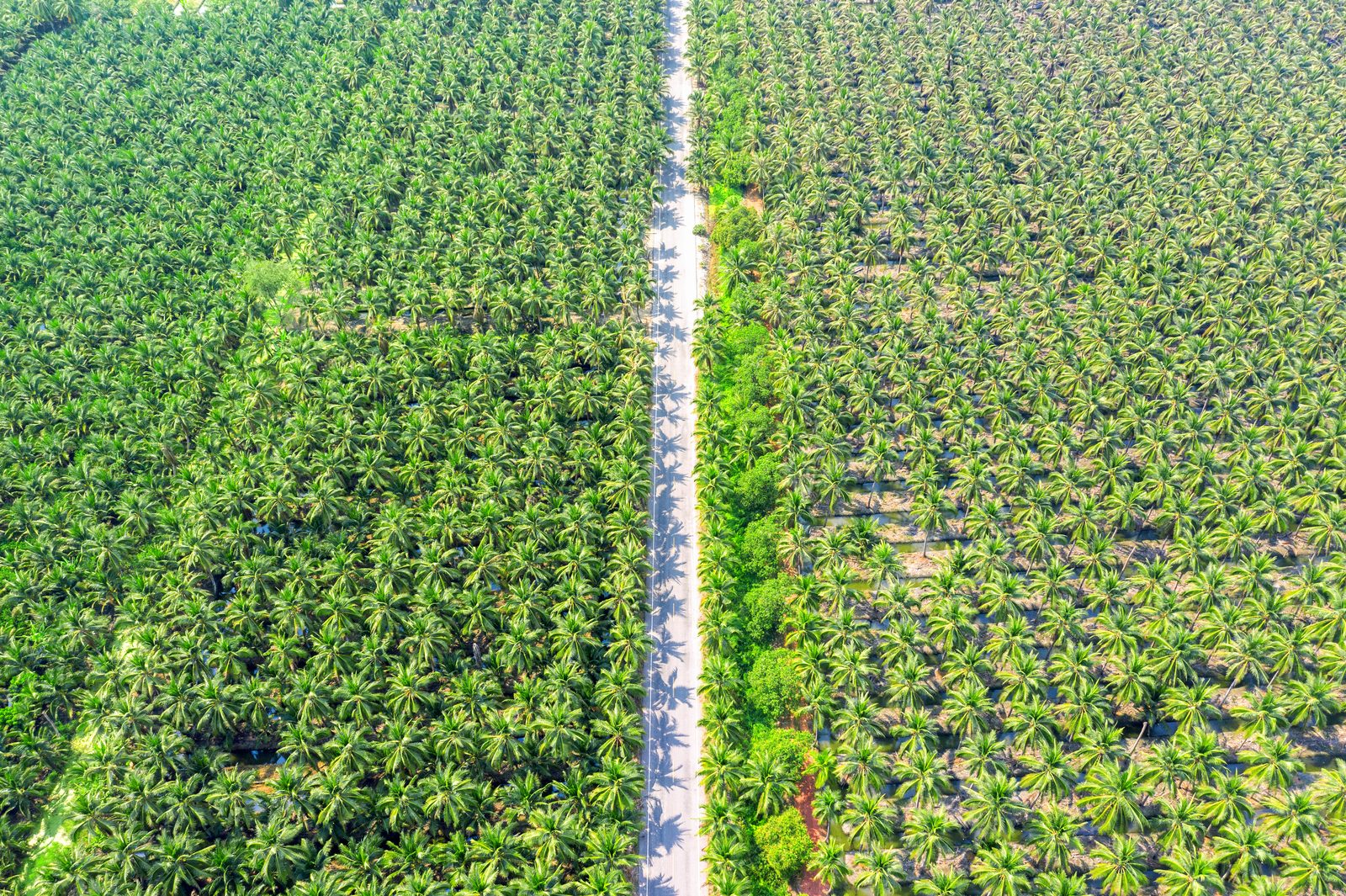
Coconut palms are long-lived (40+ years), high-value trees that reward individualized care. Our Coconut Tree Management service is the first in India to implement a per-tree digital identity system, every palm tagged with a unique ID, geolocated to centimeter accuracy, and monitored throughout its productive lifespan via satellite, drone, and field-agronomist data.
02Core Offerings
What's Included
01
Unique Tree Tagging
Each palm gets a weather-proof RFID/QR tag with GPS coordinates, age, variety, and planting record.
02
Individual Health Card
Live digital dossier per tree, crown health, disease status, nutrient history, yield record.
03
Per-Tree Yield Forecasting
ML models predict nut yield per tree per quarter, accurate to ±10%.
04
Variety Optimization
Recommendations on dwarf vs tall varieties, hybrid selection, and replanting strategy.
05
Disease Early-Warning
Satellite and drone detection of root wilt, bud rot, and stem bleeding before visible symptoms.
06
Harvest Logistics
Optimized harvest routes and scheduling to reduce labor cost and bruising losses.
03Our Process
How We Engage
01
Plantation Census
Every palm is physically visited, geotagged with RTK-GPS, and tagged with a weatherproof ID.
02
Baseline Health Audit
Crown health score, pest/disease presence, and soil test under each tree's drip zone.
03
Digital Twin Creation
All tree data ingested into our palm-management dashboard with GIS visualization.
04
Care Protocol Design
Nutrient, irrigation, and pest-control schedules customized per zone and per tree age.
05
Monthly Monitoring
Field agronomists rescore trees monthly; drone imagery captures canopy changes.
06
Yield Tracking & Analytics
Nut counts logged at each harvest, feeding predictive models for future seasons.
DDDeep Dive
The Coconut Palm: A 40-Year Engineering Problem
A coconut palm is not a crop, it is a 40+ year asset on your land. The decisions you make in year 1 (variety, spacing, basin design) compound for four decades. This deep-dive covers the variety math, the productive-lifespan curve, the per-tree nutrition budget, and the disease signatures we watch for.
01
Variety selection: Tall vs Dwarf vs Hybrid economics
The single biggest yield decision on a coconut plantation is variety. Each class has a distinct productive-life curve, spacing requirement, and per-nut economics:
Variety
First yield
Peak nuts/palm/yr
Spacing
Lifespan
Tall (WCT, ECT, LCT)
6-8 yrs
70-90
7.5 × 7.5 m (175/acre)
60-80 yrs
Dwarf (COD, MOD, MYD)
3-4 yrs
100-150
6.5 × 6.5 m (235/acre)
30-40 yrs
Hybrid (T×D: Kerasankara, Chandrasankara)
4-5 yrs
120-180
7.5 × 7.5 m (175/acre)
50-60 yrs
Hybrid (D×T: Lakshaganga, Anandaganga)
4-5 yrs
130-160
7.5 × 7.5 m (175/acre)
50-60 yrs
For commercial new plantings we typically recommend D×T hybrids. They combine early yield (year 4) with the longevity of Tall genetics and the precocity of Dwarf parentage.
The yield-lifespan curve: when does a palm pay back?
A coconut palm follows a predictable productivity trajectory. Knowing where each tree sits on this curve is essential for replacement planning and ROI projection.
Hybrid coconut palm yield curve (nuts/palm/year)
Our system flags any palm with a sustained 30%+ yield deviation from its expected curve, early warning of root rot, bud rot, or under-nutrition.
03
Per-tree nutrition budget: what the palm actually consumes
A productive hybrid palm (150 nuts/yr) removes a specific quantity of NPK from the soil every year. Replacing exactly this amount, no more, no less, is the foundation of our per-tree fertilizer prescription.
Nutrient
Annual removal per palm
Source split (Synthetic / Organic)
Best timing
Nitrogen (N)
500 g
60 / 40
4 splits: pre/post monsoon × 2
Phosphorus (P₂O₅)
320 g
50 / 50
2 splits: pre-monsoon, post-monsoon
Potassium (K₂O)
1,200 g
40 / 60
4 splits, synchronized with bunch emergence
Magnesium (Mg)
500 g
70 / 30 (Mg sulphate dominant)
Annual, basin application
Calcium (Ca)
450 g
80 / 20
Annual lime, pre-monsoon
Sulphur (S)
150 g
50 / 50
With P application
Boron (B)
5-10 g
100 / 0 (borax)
2 g per quarter, critical for nut set
K:N ratio in coconut is roughly 2.4:1, far higher than most crops. Under-K palms drop nuts, malform copra, and show yellowing fronds; the single most common deficiency on Indian plantations.
Three diseases destroy more Indian coconut production than all others combined. Our multispectral + CNN classifier picks each up before visible canopy collapse:
Root (wilt) disease: drop in NDRE coupled with frond flaccidity index; flags 6-12 months before clinical symptoms
Bud rot (Phytophthora palmivora): central spear discolouration, detected by thermal asymmetry across the crown
Lethal yellowing (phytoplasma): premature nut drop signature plus chlorophyll collapse in lower fronds
Rhinoceros beetle (Oryctes rhinoceros): V-shaped frond cuts visible in drone RGB at 2 cm/px resolution
P1Intercrop Programs
Detailed Patterns by Primary Crop
Scientifically validated intercrop combinations for each major plantation system, with crop-stage-specific selections and expected revenue per acre.
P2Region-Wise Suitability
Agro-Climatic Zone Recommendations
Every region has unique rainfall, soil, and market dynamics. Here is our zone-by-zone intercrop matrix:
04Technology
Tools & Methodology
Engineering-grade tools and scientifically validated methods underpin every deliverable.
RTK-GPS tagging (±1cm)RFID & QR weatherproof tagsMultispectral drone imageryCustom palm-health ML classifierGIS-based plantation dashboardDisease-detection neural network
05Ideal For
Who This Is For
This service delivers maximum ROI for the following profiles:
Coconut plantation owners (500+ palms)
Commercial coconut producers
Coconut FPOs
Inter-cropped coconut-cocoa/pepper farms
Coir & desiccated coconut processors
06Deliverables
What You Receive
Per-tree digital passport
Plantation GIS map
Monthly health report
Annual yield-performance review
07FAQs
Frequently Asked
How durable are the tree tags?
Our weatherproof RFID tags are rated for 10+ years of outdoor exposure. QR tags use UV-stable polymer and are replaced every 5 years as part of the service.
Can I manage inter-cropped plantations?
Absolutely. We track coconut alongside secondary crops (cocoa, banana, pepper, pineapple) in the same digital dashboard.
What yield improvement should I expect?
Clients typically see 30-50% yield improvement over 2-3 years through targeted nutrition, irrigation, and disease prevention. Poorly managed plantations see higher gains.