Back to Services
Development
Farm Development Services
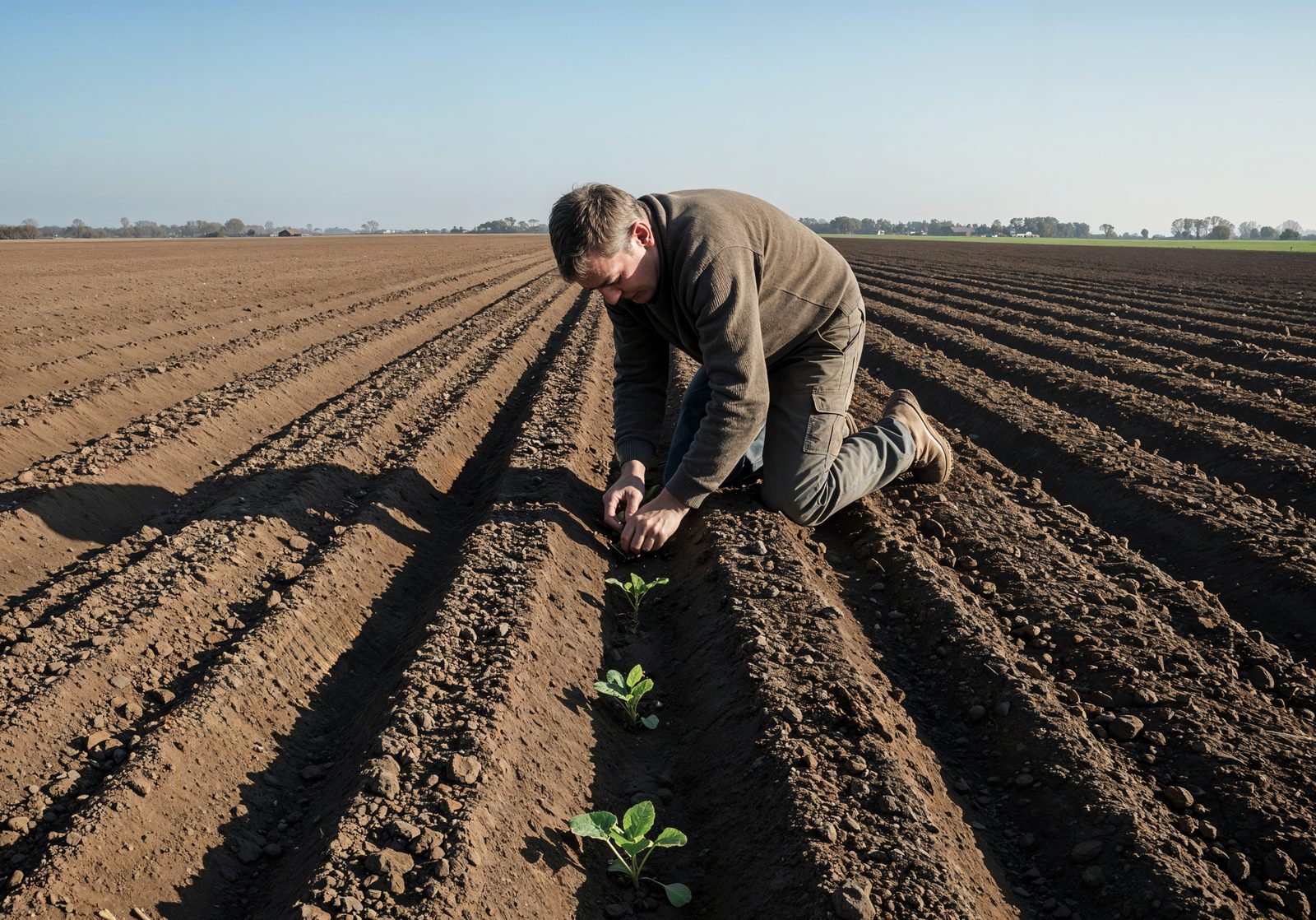
From barren land to a productive plantation. Complete farm-setup engineering, from land preparation through to handover.
From barren land to a productive plantation. Complete farm-setup engineering, from land preparation through to handover.
Setting up a farm is a capital-intensive, one-shot investment, the first decisions compound for decades. Our Farm Development Services deliver turnkey conversion of barren or underutilized land into productive, profitable farms, combining agricultural engineering, soil science, hydrology, and agronomic design into a single coordinated build.
Comprehensive land assessment: soil, water, climate, topography, and crop suitability.
Clearing, levelling (laser-guided where needed), trenching, and terracing.
Optimal row spacing, orientation, and planting geometry for light, wind, and machinery.
Farm ponds, check dams, bore-well integration, and primary irrigation networks.
Inter-cropping, border crops, and multi-tier plantation design for risk diversification.
Sourcing elite planting material, nursery setup, and precision planting operations.
Engineering team walks the land; preliminary survey of soil, water, slope, access.
Detailed blueprint: zones, infrastructure, crop mix, and budget with milestones.
Bush clearing, stone removal, deep plowing, levelling, and terrace building.
Farm roads, ponds, pump houses, fencing, and primary irrigation mainlines.
Pit digging, soil conditioning, planting-material procurement, and precise plant-out.
Full documentation, operator training, and ongoing agronomic support agreement.
Farm development decisions made in week 1 lock in your geometry, your runoff behaviour, and your machinery access for the next 40 years. We design every parameter from first principles, then build it on the ground.
Spacing is the single decision that caps your lifetime yield potential. Too dense → light competition + disease pressure. Too sparse → wasted land. Optimal varies by crop, variety, soil depth, and intended canopy management:
| Crop / variety | Spacing (m) | Plants per acre | Reasoning |
|---|---|---|---|
| Coconut (Tall) | 7.5 × 7.5 | 175 | Crown clearance at maturity ≥ 8 m |
| Coconut (Dwarf) | 6.5 × 6.5 | 235 | Smaller crown, higher density |
| Mango (Alphonso) | 10 × 10 | 40 | Wide crown, 25-yr asset |
| Mango (UHDP: Amrapali) | 3 × 2 | 675 | Ultra-high-density orchard |
| Banana (Grand Naine) | 1.8 × 1.8 | 1,250 | Standard pit planting |
| Areca nut | 2.7 × 2.7 | 550 | Often intercropped with banana |
| Cocoa (under coconut) | 3 × 3 | 450 | Shade-tolerant inter-crop |
| Dragon fruit | 3 × 3 (post) | 450 | Trellis-supported |
The pit is the only place you can permanently modify the rooting environment. We over-engineer this step because correcting later is impossible:
| Crop | Pit (L × W × D) | Amendment fill | Pre-plant treatment |
|---|---|---|---|
| Coconut | 90 × 90 × 90 cm | Topsoil 60% + FYM 25% + Trichoderma 15% | Neem cake 1 kg + rock phosphate 500 g |
| Mango | 90 × 90 × 90 cm | Topsoil 70% + Vermicompost 20% + Bone meal 10% | Carbofuran 25 g (or biocontrol equivalent) |
| Banana | 60 × 60 × 60 cm | Topsoil 60% + FYM 30% + Neem cake 10% | Carbendazim sucker dip |
| Areca | 60 × 60 × 60 cm | Topsoil 70% + Compost 25% + Mycorrhiza 5% | Bordeaux paste basal |
On flat-to-gentle land we laser-level to ±2 cm, eliminating water ponding and run-off losses. On rolling/hilly land we engineer contour terraces using the Universal Soil Loss Equation (USLE) to predict and prevent erosion.
For rainfed and supplemental-irrigation farms, an on-farm pond converts wet-season runoff into dry-season survival water. Sizing balances catchment runoff against irrigation deficit:
Engineering-grade tools and scientifically validated methods underpin every deliverable.
This service delivers maximum ROI for the following profiles:
Book a consultation with our agronomy team. We'll assess your farm and design a tailored plan, no obligation.
Book Farm Analysis