Back to Services
Water
Irrigation Management
Satellite-driven precision irrigation that puts the right water, at the right time, into the right root zone.
Satellite-driven precision irrigation that puts the right water, at the right time, into the right root zone.
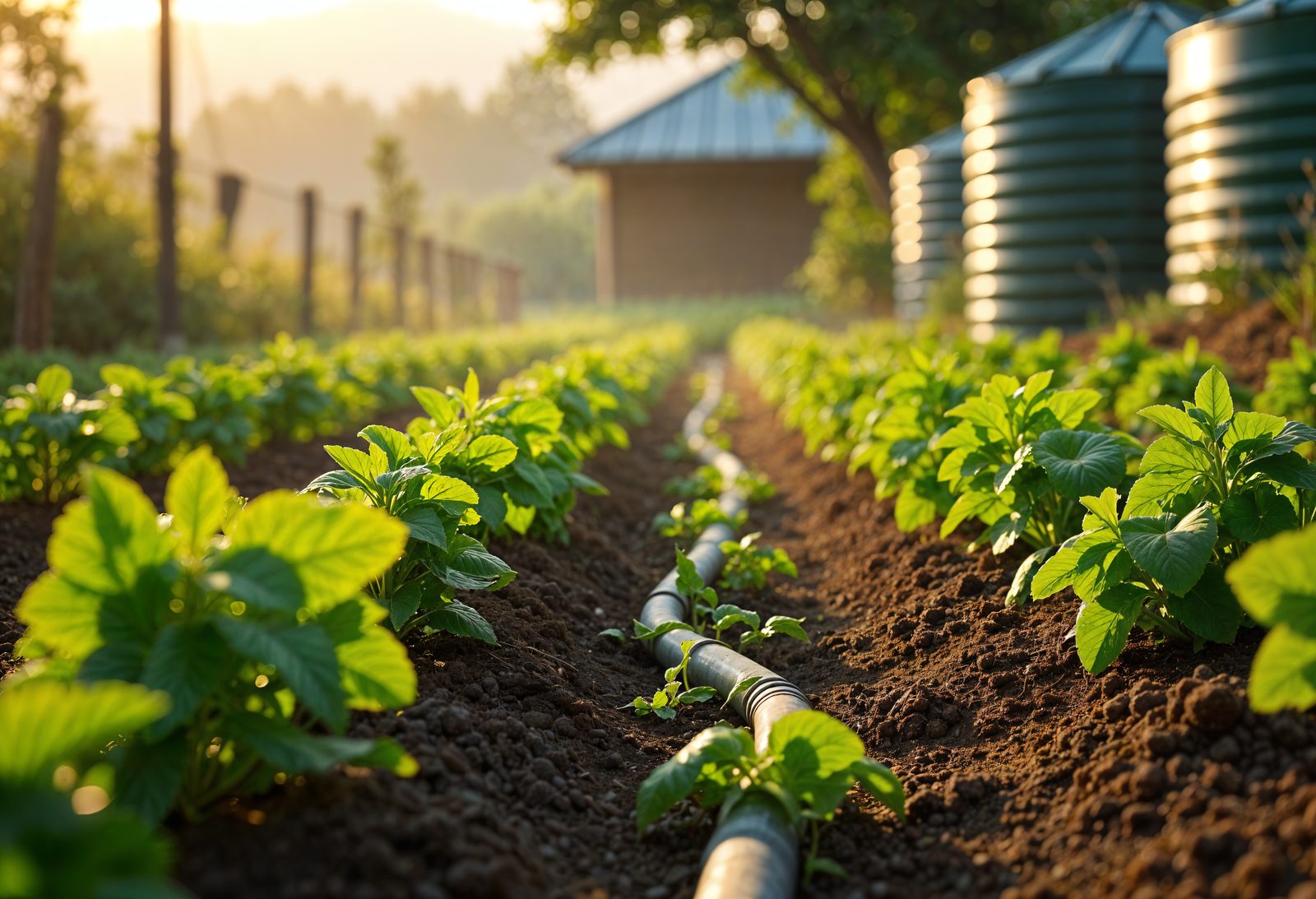
Our Irrigation Management service combines satellite soil-moisture retrieval (Sentinel-1 SAR), evapotranspiration models, and 14-day weather forecasts to deliver water with surgical precision. We design, install and maintain end-to-end drip and sprinkler systems, then issue daily watering recommendations your field team executes. No IoT hardware needed.
Custom drip or sprinkler networks engineered around your crop, topography, and water source.
Sentinel-1 SAR estimates root-zone moisture every 6-12 days, no field probes needed.
Per-zone watering recommendations based on ETc, satellite soil moisture and 14-day weather.
Field agents execute the daily plan zone by zone and log completion in the mobile app.
Venturi and dosing-pump integration for precise nutrient delivery with irrigation.
Filter cleaning, emitter flushing, leak audits, and seasonal recalibration included.
Flow rate, pressure, water quality (pH, EC, hardness), and seasonal availability assessment.
Pipe sizing, pump selection, and emitter layout engineered using Hazen-Williams equations.
Trenching, mainline + sub-main + lateral laying, valve and filter assembly, and commissioning.
Each zone digitised on the dashboard and tied to its valve so the daily plan is unambiguous.
Daily plan published in the app; agronomist verifies before field team executes.
Monthly reviews adjust the recommendation engine to crop growth stage, weather, and soil response.
Modern precision irrigation is the highest-ROI engineering upgrade an Indian farm can make. The right drip system, sized correctly, scheduled by evapotranspiration, can save 30-50% water and lift yield 20-40% on the same plot. Below is the technical detail we use when designing for each crop.
Not all drip is created equal. Inline-PC laterals look identical to non-PC laterals from outside but behave very differently under pressure variation. The choice depends on terrain, water quality, crop spacing, and the lateral length you need to feed.
| System | Best For | Pressure Range | Cleaning Type | Field Life |
|---|---|---|---|---|
| Surface PC inline drip (e.g. Netafim DripNet PC, Streamline X) | Row crops, vegetables, vineyards, undulating fields | 0.5 – 4.0 bar (pressure-compensating) | Self-flushing per emitter cycle | 7 – 10 yrs |
| Subsurface drip (SDI) (e.g. Netafim DripNet PC AS with anti-siphon + Bioline) | Sugarcane, cotton, maize, alfalfa, turf, orchards | 0.5 – 4.0 bar | Continuous self-flush + root-intrusion barrier (Cupron/Treflan) | 15 – 25 yrs |
| Non-PC drip laterals | Flat fields, lateral runs < 60 m, low-cost vegetable plots | 0.8 – 1.2 bar (narrow band) | Manual flush | 3 – 5 yrs |
| Micro-sprinklers / micro-jets | Orchards (mango, coconut, citrus), nurseries, frost-protection sets | 1.5 – 3.0 bar | Filter at head + manual | 8 – 12 yrs |
Netafim invented modern drip irrigation in 1965 and remains the global benchmark. Their DripNet PC lateral is the workhorse we specify on most plantation projects because of three properties:
| DripNet PC Model | Discharge | Spacing options | Typical lateral length |
|---|---|---|---|
| DripNet PC 16010 | 1.0 L/h | 20 / 30 / 50 / 75 cm | up to 180 m |
| DripNet PC 16016 | 1.6 L/h | 30 / 50 / 75 / 100 cm | up to 160 m |
| DripNet PC 16020 | 2.0 L/h | 30 / 50 / 75 / 100 cm | up to 140 m |
| DripNet PC 16035 | 3.5 L/h | 50 / 75 / 100 / 150 cm | up to 110 m |
Subsurface drip buries the lateral 15–40 cm below the soil surface, delivering water directly into the root zone. It is the most water-efficient irrigation method ever engineered:
Our daily recommendation engine is built on the FAO-56 Penman-Monteith reference evapotranspiration model, the global standard for irrigation scheduling. The math is simple in structure, brutal in its requirements: it needs accurate weather, accurate soil moisture, and accurate crop coefficients.
Distribution Uniformity measures how evenly water reaches every emitter in a zone. Poor DU is the silent yield killer: an 80% DU system over-waters 20% of the crop and starves the other 20%, suppressing yield by 15-25% with no visible symptom.
Engineering-grade tools and scientifically validated methods underpin every deliverable.
This service delivers maximum ROI for the following profiles:
Book a consultation with our agronomy team. We'll assess your farm and design a tailored plan, no obligation.
Book Farm Analysis