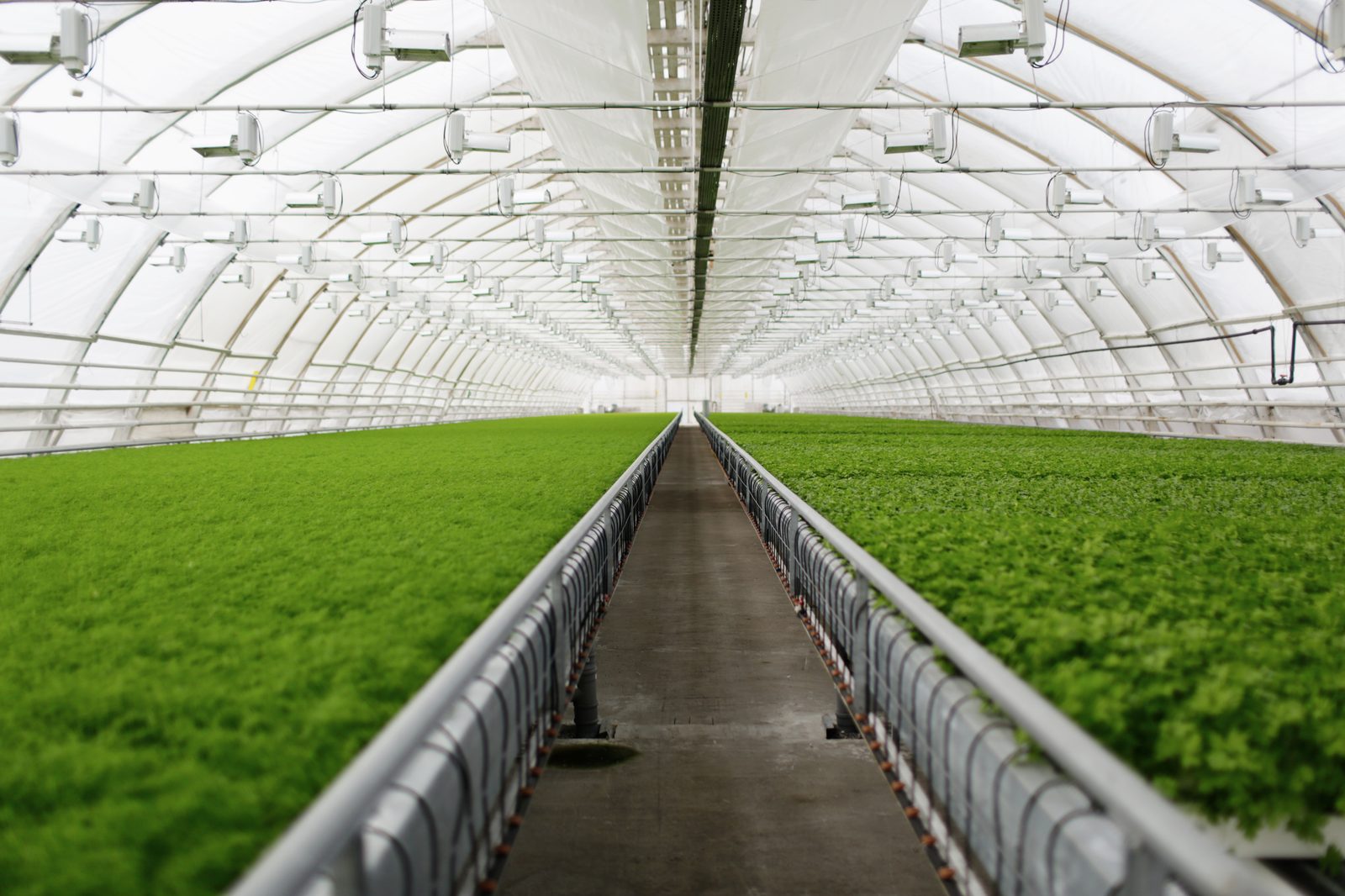
End-to-end protected farming: polyhouses, net houses, tunnels, fully-closed climate rooms and hydroponic soilless systems. Satellite-linked climate control lets you grow export-grade produce year-round, regardless of the weather outside.
Open-field farming exposes your capital to weather, pests, and seasonality. Our Polyhouse & Hydroponics service builds protected-environment systems that hold climate, water, and nutrients at exact set-points, so you can grow premium crops (exotic vegetables, flowers, leafy greens, strawberries, medicinal plants) reliably, any season, anywhere. From a simple shade-net to a fully-sealed, CO₂-enriched climate room with fan-pad cooling and hydroponic nutrient delivery, we design and build the exact protection level your crop needs, and integrate live satellite data so external weather still drives internal set-points.
Sealed greenhouse with cellulose cooling pads on one wall and exhaust fans on the opposite wall. Evaporative cooling drops internal temp 10-15°C below ambient. Critical for summer-sensitive crops (exotic lettuce, gerbera, anthurium) in Indian conditions.
03
Shade-Net / Insect-Net House
UV-stabilized HDPE nets (35% / 50% / 75% / 90% shade) on steel/bamboo frames. Cheaper than polyhouse, ideal for leafy greens, coriander, marigold, nursery raising, and pollinator-exclusion zones for seed production.
04
Tunnel & Low-Tunnel Farming
Walk-in high tunnels (6-8 m wide) for vegetables/strawberries; low tunnels (0.6-1 m) over raised beds for season-extension and frost protection. Minimal-capex protected cultivation, payback in a single season.
05
Fully-Closed Climate Room (CEA)
Sealed indoor growing with LED lighting, HVAC, CO₂ enrichment, dehumidification. Pharma-grade medicinal herbs, vertical-farm leafy greens, microgreens, mushrooms. Zero external variability.
06
NFT / DWC / Aeroponic Hydroponics
Soilless cultivation systems. Nutrient Film Technique (NFT) channels for leafy greens, Deep Water Culture (DWC) rafts for basil/lettuce, aeroponic towers for vertical growing, Dutch-bucket for tomatoes/capsicum. 90% less water than soil farming.
07
Satellite-Integrated Climate Control
Our live satellite feeds, 5-day weather forecast, incoming-radiation maps, storm tracking, pre-adjust your polyhouse fans, vents, foggers, and curtains BEFORE the weather front hits. External data drives internal set-points automatically.
08
Fertigation & Nutrient Dosing
Automated injection of precisely mixed A+B hydroponic stocks (NPK + micros + pH/EC control) synchronized with crop growth stage. Dosing pumps, EC/pH probes, and weekly recipe adjustments.
Decide what to grow based on your local market, export window, and protected-farming ROI (exotic vegetables, flowers, leafy greens, strawberries, medicinal).
02
Site & Climate Audit
Temperature range, humidity, wind, solar radiation, and water quality assessed. Structure type (polyhouse vs fan-pad vs net house vs tunnel) matched to site conditions.
03
Structural Design
Galvanized-steel frame sized for wind/snow loads per IS codes, polyfilm/net specifications finalized, foundation plan prepared. CAD drawings at 1:100 scale.
04
Hydroponic System Design
System (NFT / DWC / aeroponic / Dutch-bucket) selected for crop; plumbing, tank sizing, nutrient-recipe stages, and dosing equipment all engineered.
05
Subsidy Pre-Approval
DPR prepared and submitted to NHB/MIDH BEFORE construction. Typical 50% subsidy on capex for certified structures.
06
Build & Fit-Out
Foundation, frame erection, film/net cladding, cooling-pad and fan installation, hydroponic plumbing, electrical, and IoT sensor network, all in-house and coordinated.
07
Satellite Integration & Commissioning
Climate controller linked to our live satellite/weather feeds, set-points calibrated to crop stage, sensors validated, nutrient recipes loaded, seedlings planted.
08
Operation & Agronomist Support
Daily app-based monitoring, weekly remote reviews, on-site visits during critical windows. Annual maintenance covers film replacement, pad changes, pump servicing.
Protected farming is applied environmental engineering. Every variable inside the structure (temperature, humidity, CO₂, light, root-zone EC and pH) is independently controllable, and the engineering decision is how tightly each one needs to be controlled for the specific crop and the local climate.
01
Structure selection: which protection level for which crop
The right structure is the cheapest one that delivers the climate range your crop needs. Over-engineering is a common ₹40-60 lakh mistake.
Structure
Capex (₹/m²)
Internal temp range
Best crops
Payback
Low tunnel
250-500
+4 to +8 °C above ambient
Winter vegetables, strawberry, frost protection
6-12 months
Net house (50-75% shade)
400-700
-3 to -5 °C below ambient
Leafy greens, nursery, summer shade
12-18 months
NV polyhouse (200 µ film)
900-1,500
+3 to +8 °C above ambient (ventilated)
Off-season tomato, cucumber, capsicum, roses
18-30 months
Fan-pad greenhouse
1,800-2,500
-8 to -15 °C below ambient (cooled)
Gerbera, exotic lettuce, anthurium, strawberry
24-30 months
Fully closed CEA + LEDs
4,000-7,000
Set-point ±0.5 °C (any value)
Pharma herbs, vertical-farm lettuce, microgreens
24-36 months
02
Fan-pad evaporative cooling: the psychrometric math
Fan-pad systems cool by adiabatic evaporation: they trade sensible heat for latent heat as water evaporates off the cellulose pad. The lower the ambient humidity, the more cooling you get. Performance is bounded by the wet-bulb temperature.
Theoretical pad outlet temperature
T_out = T_in − ε · (T_in − T_wb)
T_in = ambient dry-bulb temperature (°C) · T_wb = wet-bulb temperature (°C) · ε = pad efficiency (0.80 – 0.90 for 100 mm cellulose at correct face velocity)
Required fan airflow
Q_fan = (V_house × N_air) ÷ 60 (m³/min)
V_house = greenhouse volume (m³) · N_air = air changes per minute = 1.0-1.5 (typical for fan-pad). Place fans 30-40 m from pads max.
In Pune summer (40 °C dry-bulb, 22 °C wet-bulb), a properly sized fan-pad system delivers 24-26 °C inside, perfect for capsicum, gerbera, and exotic lettuce.
03
Hydroponic system comparison: NFT vs DWC vs Aeroponic vs Dutch-bucket
Each soilless system trades off complexity, capex, crop range, and reliability differently. We match the system to the crop, not the other way around:
System
Best crops
Capex (₹/m²)
Water re-use
Failure mode
NFT (Nutrient Film Technique)
Lettuce, basil, herbs, leafy greens
2,200-3,500
95-98%
Pump failure → root drying within 30 min
DWC (Deep Water Culture)
Lettuce, basil, bok choy, ornamentals
1,800-2,800
99% (closed reservoir)
O₂ starvation if airstone fails
Aeroponic (root mist)
Microgreens, vertical lettuce, seed potato
4,000-7,000
95-97%
Nozzle clog → instant root desiccation
Dutch-bucket (drain-to-waste / recirculating)
Tomato, capsicum, cucumber, melon
1,400-2,200
70-85%
EC build-up if drain fraction too low
04
Nutrient solution chemistry: EC and pH set-points
Every hydroponic crop has a target EC (electrical conductivity, total nutrient strength) and pH (root-zone ion availability) window. Drift outside this window stunts growth or burns roots within days:
Crop
EC target (dS/m)
pH target
N:K ratio in nutrient stock
Lettuce
1.2 – 1.8
5.8 – 6.2
1 : 1.5
Basil
1.0 – 1.6
5.5 – 6.5
1 : 1.3
Spinach
1.8 – 2.3
6.0 – 6.5
1 : 1.4
Tomato (vegetative)
2.0 – 2.5
5.8 – 6.3
1 : 2.0
Tomato (fruiting)
2.5 – 3.5
5.8 – 6.3
1 : 2.8
Capsicum
2.0 – 3.0
5.8 – 6.3
1 : 2.5
Strawberry
1.4 – 2.0
5.8 – 6.5
1 : 1.8
05
Daily Light Integral (DLI): when natural light is not enough
Plants integrate light over the day. The cumulative photon flux (DLI) determines yield more than peak intensity. For closed-CEA and winter-NV polyhouses, we calculate the DLI deficit and design LED supplementation to close the gap.
Crop
Min DLI (mol/m²/d)
Optimal DLI
LED supplement if < min
Lettuce
10
14-17
Yes, 18 hr photoperiod
Basil / herbs
12
16-20
Yes
Tomato
20
25-35
Critical in winter
Cucumber
18
22-30
Yes
Strawberry
17
20-25
Yes
Saffron
12
15-18
Indoor CEA only
Daily Light Integral
DLI = PPFD × h × 3600 ÷ 1,000,000
DLI = mol/m²/day · PPFD = µmol/m²/s (typical PAR sensor reading) · h = photoperiod hours
P1Intercrop Programs
Detailed Patterns by Primary Crop
Scientifically validated intercrop combinations for each major plantation system, with crop-stage-specific selections and expected revenue per acre.
P2Region-Wise Suitability
Agro-Climatic Zone Recommendations
Every region has unique rainfall, soil, and market dynamics. Here is our zone-by-zone intercrop matrix:
04Technology
Tools & Methodology
Engineering-grade tools and scientifically validated methods underpin every deliverable.
Polyhouse vs net house vs tunnel vs fan-pad, which do I need?
It depends on your crop and climate. Net house (Rs.400-700/sqm) for leafy greens and summer-shading where heat is the only issue. Polyhouse NV (Rs.900-1,500/sqm) for off-season vegetables and flowers where rain + pest exclusion matter. High tunnel (Rs.250-500/sqm) for frost/rain protection at minimal cost. Fan-pad greenhouse (Rs.1,800-2,500/sqm) when summer heat is severe and you grow premium crops (gerbera, exotic lettuce, strawberry). Fully-closed CEA (Rs.4,000+/sqm) for pharma-grade, vertical-farm, or microgreen operations. We recommend the right one after visiting your site.
What is hydroponic / soilless cultivation, and why choose it?
Hydroponics grows plants in nutrient-enriched water, with roots suspended in channels (NFT), floating rafts (DWC), sprayed with mist (aeroponic), or planted in inert media like coco-peat or perlite (Dutch-bucket). Advantages: 90% less water than soil, no weeds, no soil-borne diseases, 3-5x higher plant density, precise nutrition control, faster crop cycles. Ideal for leafy greens, herbs, strawberries, tomato, capsicum.
How does satellite data help inside a closed polyhouse?
The crops are protected, but the environment you set is still driven by outside weather. Our live satellite + IMD feeds predict incoming storms, heatwaves, cold fronts, and radiation peaks 3-5 days out, and the app auto-adjusts your set-points (close vents before rain, open them before heatwave, dim foggers on cloudy days). Outside tracking of pest pressure and regional disease outbreaks also triggers preventive sprays. Satellite data prevents 80%+ of protected-farming crop failures caused by reactive climate control.
How does a fan & pad cooling system actually work?
Cellulose cooling pads (corrugated honeycomb media) are mounted on one wall and kept continuously wet with recirculating water. Exhaust fans on the opposite wall pull air through the pads, water evaporates, absorbing heat from the air (latent-heat principle). Incoming air cools 10-15°C below ambient and is pulled across the crop before exhausting. In Indian summer (40-45°C outside), inside temperature holds at 28-32°C, perfect for capsicum, lettuce, gerbera, exotic tomato.
What does a fully-closed (CEA) climate room give me?
Total control. No sunlight dependency. LED grow lights replace the sun. Temperature, humidity, CO₂, and air flow all independently controlled. Crops grow 30-50% faster (with CO₂ enrichment), pesticide-free, year-round, anywhere, including basements and rooftop warehouses. Ideal for pharma cannabis, saffron, vertical-farm lettuce, microgreens, mushrooms. Highest capex, highest control, highest-value crops.
Do you integrate everything on the mobile app?
Yes. The polyhouse sensors (temp, RH, PAR, CO₂, EC, pH) and actuators (fans, foggers, vents, curtains, dosing pumps) all stream to the same app as your satellite data, agronomy alerts, and ERP. Our agronomist monitors remotely and adjusts recipes weekly. You see one dashboard for the whole farm.
What subsidies apply?
NHB and state horticulture departments typically subsidize 50% of polyhouse, shade-net, and hydroponic capex, higher for SC/ST and hill-state farmers. MIDH adds on top for certain crops. Our team handles DPR, application, sanction, and disbursement end-to-end.
What is the payback period?
Crop-dependent: high-tunnel vegetables pay back in 12-18 months, polyhouse capsicum/cucumber in 18-30 months with subsidy, fan-pad gerbera in 24-30 months, fully-closed CEA leafy greens/microgreens in 24-36 months. Structural life is 15-20 years, so net ROI is 5-10x over lifetime.